

Uncle Sam
Created by Will Eisner & Lou Fine

NAME + ALIASES:
The American Spirit, Taylor Samuel
Hawke, Samuel Augustus Adams, Sam Wilson, Patriot
KNOWN RELATIVES:
Bea (Hawke's wife), Columbia ("sister")
GROUP AFFILIATIONS: Freedom Fighters, All-Star Squadron
FIRST APPEARANCE:
National
Comics #1 (July
1940).
Retooled as the American Spirit/Taylor Samuel Hawke/The
Minuteman: The Spectre vol. 2 #38.
As
Samuel Augustus Adams (Uncle Sam I): The Spectre vol. 2 #38 (Feb. 1996).
As Sam Wilson (Uncle Sam III): National Comics #1 (July 1940) (“Wilson”
named in Spectre vol. 2 #49)
As the Patriot: The Spectre vol. 2 #50 (March 1997)
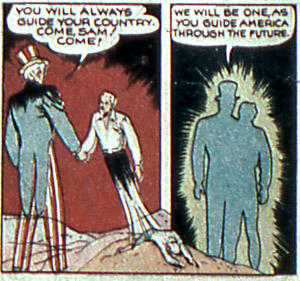
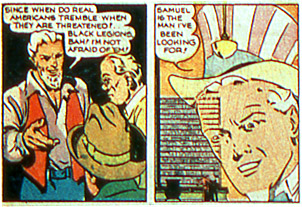
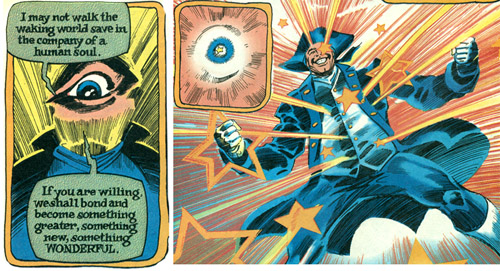
Uncle Sam’s origin has been told four times, first in National Comics #5, which was retold rather faithfully in Secret Origins vol. 2 #19 by Len Wein and Murphy Anderson. There is also a text feature in Uncle Sam Quarterly #1 written from the perspective of Buddy, Sam’s sidekick. It’s a testament to Sam’s moral qualities: “He worked awful hard to make this country as swell as it is today, and he gets good and mad when anybody tries to upset his way of living.”
Then Sam’s fictional history at DC was retooled for modern times by John Ostrander and Tom Mandrake in their epic “Haunting of America,” which ran in The Spectre vol. 3 #38-50. Ostrander’s retelling retained the essentials but added a bit more real life history to the mix. Whereas originally, the American Spirit had always been called Uncle Sam, Ostrander’s version was first called “the Minuteman” during the Revolutionary War.
In real history, the term “Uncle Sam” wasn’t coined until the early 1800s, so Ostrander’s spirit went by other names such as “Brother Jonathan”—a similar figure in top hat and striped pants—until that time. The first historical mention of “Uncle Sam” in print was in 1816’s Adventures of Uncle Sam in Search After His Lost Honor by Frederick Augustus Fidfaddy. His now-recognizable appearance came much later, in 1861. Ostrander’s Samuel Augustus Adams was created as a contemporary of real life political cartoonist Thomas Nast. Nast’s cartoons criticizing the Tweed gang are represented (as Adams’) in The Spectre #38.
1777: The American Talisman is Born
The being known as “Uncle Sam” is actually the manifest, mystical spirit of America. In different eras, this spirit has chosen to bond with like-minded individuals, many of whom happened to bear the name “Samuel.”
In 1777, just after the American colonies had declared their independence, a group of thirteen patriots, one from each state, convened to define and protect the new nation’s spirit. To help in this mystical endeavor, they enlisted an alchemist named Taylor Samuel Hawke. With the combined will of the men, an American Talisman was created. This Talisman provided a physical link to the new spirit, which manifested itself as a great eye atop a pyramid. Likewise, the Talisman itself sported this image; and on the reverse, an eagle. Hawke was entrusted with the Talisman, and at a key point in the Revolutionary War, he undertook a suicide mission to divert Hessian soldiers away from a supply convoy. The gambit worked, but Hawke was slain by the Hessians. As he lay dying, the American Spirit came to him and offered new life. Hawke became a host for the new Spirit, and the new nation would come to call this being the Minuteman. (National #5, The Spectre v.2 #37-38) Note: In the National Comics origin, the first host’s name was only “Samuel” and the hero was only ever called “Uncle Sam.” With the retooling in The Spectre, his aliases were changed to be historically appropriate.
In one account, the original Sam (Hawke) was shown in his home, with his wife, Bea. She worried that the old man was biting off more than he could chew by serving in the revolution. (In his younger days, he’d served in the French and Indian conflict.) (Uncle Sam #1)
After the revolution, the American Spirit waned. It would rise repeatedly in times of great crisis to serve as a beacon for Americans. In the period leading up to the War of 1812, it was reborn as Brother Jonathan, a figure in top hat and suit. During the Civil War, the Talisman was split in two, creating opposing spirits, Billy Yank and Johnny Reb. (The Spectre #38)
Uncle Sam and WWII
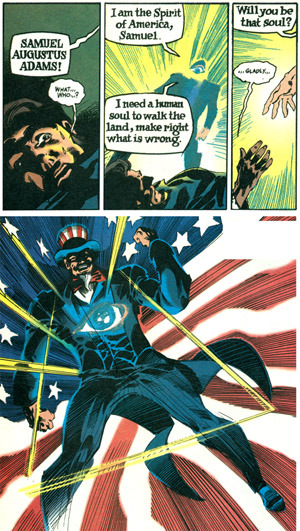
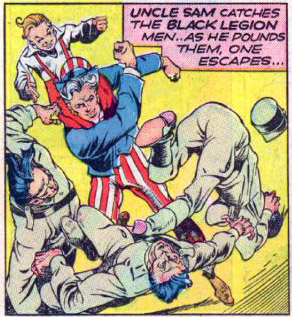
The character of Uncle Sam grew in America’s popular culture throughout the 1800s. In the 1870s, he was given form by a Nast political cartoonist named Samuel Augustus Adams. As it happened, Adams had come to possess the halved American Talisman. His cartoons drew fire from his detractors—literally. Adams was accosted at gunpoint for expressing his views. The American Spirit saved his life as it had others before, and the mighty Uncle Sam was borne. The American Spirit manifested itself again as Uncle Sam during World Wars I and II. (The Spectre vol. 2 #38)
When the threat of Axis evil began to threaten America, the spirit came across Samuel Wilson in the town of Glen Valley. Seeing the potential in this mercantile owner, the spirit empowered “Old Man Sam,” and he was created as the third Uncle Sam. There he overthrew the threat of the Black Legion. (National #5, Spectre vol. 2 #49) Note: Again, the last name “Wilson” was a DC addition, first mentioned in The Spectre #49.
The spirit of America began taking a direct role in defending the U.S.A. His first foe was the Cobra, and his henchmen Snyle and Scar. (The Spirit’s first foe was also called Dr. Cobra.) Cobra was attempting to organize disillusioned citizens under a Nazi-esque banner called the Purple Shirts (real Nazis were often called “brown shirts”). Their foreign benefactors also made their move and kidnapped the U.S. President. When they captured Sam as well, the hero’s rhetoric stirred some of the recruits, inciting them to revolt against the Shirts. The Army arrived then and Uncle Sam delivered the President to safety. Uncle Sam also adopted a sidekick, the young boy named Buddy Smith, whose father Ezra was killed by the terrorists. Buddy was a convenient vehicle by which Eisner could teach young readers “what they could do.” On one hand, Sam was unafraid to send Buddy into mortal danger, and on the other, he constantly panicked about the boy’s resulting predicaments. (National #1) Sam took time to train Buddy, teaching him skills like tracking. (#5) He once referred to Buddy as his nephew, thought this was not biologically true. As Sam explained it, “every red-blooded American boy is my nephew!” (#20)
For being a contemporary incarnation of the nation’s zeitgeist, Sam sometimes acted in odd ways. For example, he would scale a building instead of using a modern convenience like the elevator. And even though he was silver-haired, Sam was always drawn to look fit (sometimes shirtless) and fairly young in National Comics.
Uncle Sam wasn’t beneath tackling mundane threats like J.P. Potter, who sickened kids with inferior candy. (#2) But more often his adventures concerned national security, like when he stepped in to help the Philippines against an expansionist power of Mias and his brute of a general, Yiffendi. Sam rallied the locals to take back their land. (#3)
America wasn’t yet at war but Uncle Sam uncovered plenty of foreign threats. European dictators built a “sub tank” that crossed the ocean floor to attack America. By coincidence, Uncle Sam was enjoying a fishing trip and discovered their approach. (#7)
The Black Legion returned again, attempting to infiltrate America’s manufacturing. Somehow they managed to cause mass blindness, but Sam traced them to a Pacific Island and alerted the military to intercept their foreign invasion. He cured the blindness, too. (#14)
Spies found a fertile ground for an attack on the movie set of director Emil Von Blon. The Warren Bros. director was so successful and powerful that he procured the use of a fleet of US Navy ships. The picture was meant to stir American patriotism, but the set was infiltrated by Nazi Fifth Columnists. Buddy—who was onboard one of the submarines to help with the filming—got wise and turned the tables on the saboteurs, taking one of their guns and making his escape through a torpedo bay. Meanwhile, the spirit of George Washington appeared to Uncle Sam and alerted him to the danger. Buddy and Sam defeated the spies, but only after several ships had been destroyed. (#16) Tales like this one were typical across the Quality line, where Axis countries and leaders were not named explicitly, but the intention was clear. National #16 clearly depicts a swastika.
A Dime for a Quarterly
At about this time (mid-1941), Uncle Sam was awarded his own quarterly title. When pointing to Will Eisner’s best work, people ofen cite “The Spirit,” but at this point in history, Eisner’s work on Uncle Sam Quarterly far outshines that feature. The first issue was a beautiful creation featuring some of his most creative artwork to date. It consisted of four chapters and a double-page map of Sam’s hometown, Everytown. Unlike Doll Man Quarterly, which launched at the same time, this issue only ran stories about the title character. Uncle Sam Quarterly lasted for only eight issues before being retitled Blackhawk. The tales in this title were much more fanciful than those in National Comics.
When Senator Northrup Bristol forced a “Youth Training Bill” through Congress, children across the country were herded into near-slavery. Bristol’s ambitions grew so far as to kidnap the President and assassinate his detractors in order to pass further fascist laws. In time they came to recruit Buddy as well. Uncle Sam was powerless to save him—it was the law. Meantime, Bristol hired a sculptor named Curwen to mold faces and create a duplicate of Uncle Sam and others. Bristol cried for war, but the nation wasn’t ready. Uncle Sam freed himself and rallied the country and military to end Bristol’s fevered plans. (Uncle Sam Quarterly #1)
Issue #1’s second tale reads like the Spirit. In it, the strange Dr. Link and Dr. Blink brought King Killer back to life à la Frankenstein. Killer was nigh unstoppable; with fangs and fearsome strength, only a protracted battle with Uncle Sam could bring him down. Killer returned in U.C.Q. #2 for round two. Uncle Sam was forced to bury him in a collapsed mine shaft. Another monster was created by biologist Jeremiah Korntooth, who engineered the fanged and pinheaded Mongrol Men. He offered these men to the Axis powers; these also tested Sam’s strength and cunning. (U.C.Q. #4)
The remaining tales of Uncle Sam Quarterly #1 speculated about American life under fascist rule. But for all his strength, Uncle Sam’s greatest weakness was his country’s lack of faith. After the Star-Record newspaper ran an article doubting his existence, Sam’s powers began to wane. According to a rebuttal written by Buddy: “The only time that anyone ever came close to licking him was the time that the people stopped cheering for him and he lost his strength.” As steel-helmeted invaders took over America, Uncle Sam fell ill and disappeared completely. He found himself in another world where he was told the only way back was to fight through “swamps of ignorance and of jungles of lies.” After completing these trials, he returned to America and its citizens embraced him again. This gave him the strength to overthrow their captors. (U.C.Q. #1)
The second issue was another masterwork. One sprawling tale followed Sam and Buddy into Kidland, an underground fantasy world where children never grew old. Sam saved the residents of Kidland from the Wicked Witch Queen and her giants. In another, he faced the Fiddler of death whose violin sounds could control animals. The splash page of this story even prints sheet music for the Fiddler’s song! Another stunning feature took an unconventional approach to storytelling and broke the “fourth wall” between Quality’s characters and readers. In it, the comic book villains revolted and leapt from the page to enslave the comics’ creators. The story is written in rhyming verse and ultimately Uncle Sam righted things by convincing the villains to return to their role: “Cause the kids must have their heroes, And the heroes must have foes, So the villains should return to work, Before the trouble grows.” (#2)
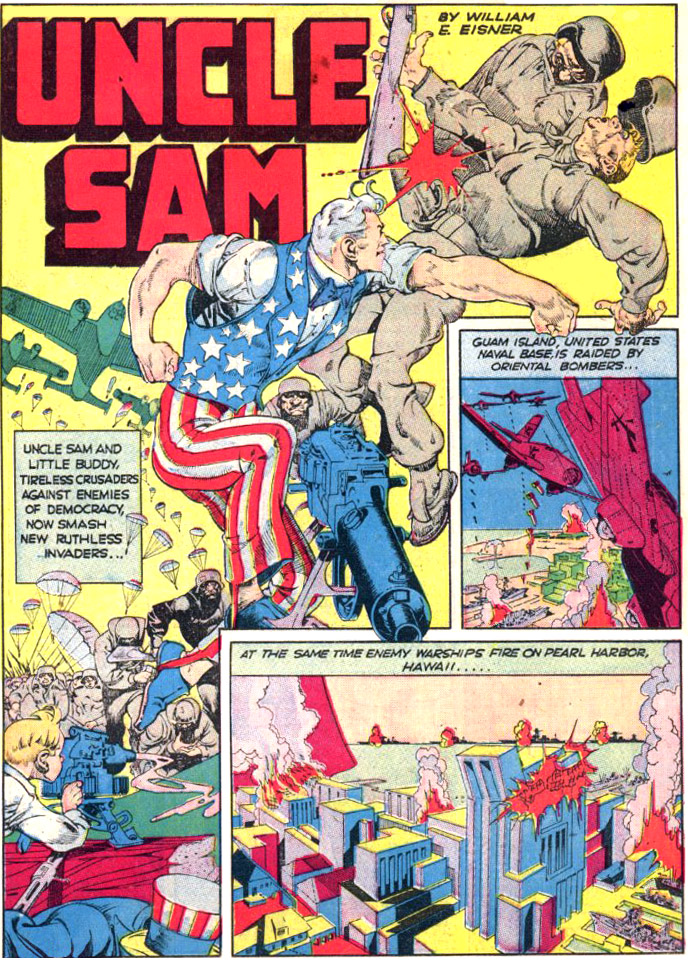
The story in National Comics #18 featured an eerily ominous bombing of Pearl Harbor. Although the cover is dated the same month as the attack, Dec. 1941, this comic was probably produced as much as six months before that. In the previous issue (#17), the Black Guard (formerly Legion) returned to threaten U.S. forces in Panama. The Axis spread a wider net next, attacking Pearl Harbor, Guam, and Portland, Maine. It was Buddy’s idea to build a wire net that was carried below airplanes to foul up the invaders’ plane props. While defending the seas near Maine, Uncle Sam encountered the spirit of Capt. John Paul Jones, the “Father of the American Navy.” That inspired Sam to use America’s retired frigates to encircle the enemy in fire. In the meantime, Boston was also invaded by enemy soldiers (#18)
Many stories, especially those in the Quarterly title, dealt with historical topics. The spirit of Simón Bolívar (the first president of Columbia) even approached the spirit of George Washington to recruit Uncle Sam to help fight the Nazis in South America. Together he and Buddy decimated an air attack launched from Africa. (#20)
One time he intervened during the sentencing of some underage thugs, and begged the court’s mercy. Instead, Sam took the four boys under his wing (all save one, who had actually killed a man). Surprisingly (for a story by a Jewish writer), the boys’ reformation began with a Sunday trip to church! (#22)
World War II
You can’t write a feature titled “Uncle Sam” and not have stories about the U.S. involvement in the war. The cover of National #23 (June 1942) may have been one of the first produced after Pearl Harbor; it depicts the Japanese as enemies.
Here, another interlude about Sam’s role in the DC universe… In All-Star Squadron #31-32, Uncle Sam told the story of how he’d assembled the first team of Freedom Fighters (Invisible Hood, Magno, Miss America, Neon, the Red Torpedo, and Hourman). This team tried unsuccessfully to stop the Japanese attack on Pearl Harbor. They all seemingly perished, and later Uncle Sam assembled a second team who fared better. They eventually broke off from the All-Star Squadron to work directly for officials in Washington.
Whether because of Eisner’s departure from the feature, or for the passions of war, the tone of “Uncle Sam” shifted considerably with National #28 (Jan. 1943). The art was signed by Al Gabriele, and the lettering style was new. In a story narrated by “Father Time,” Sam took out a machine gun and mowed down the enemy Japanese. Sam also appeared in that issue’s “Kid Patrol” feature, as a mentor. He encouraged them to perform in order to raise money for war bonds. (#28)
Sam traveled into the heart of Nazi Germany itself to assist his friend, the guerilla leader called the Vagabond. Sam and Buddy supplied the Vagabond’s band with weapons to fight the Führer. (#37)
Uncle Sam was removed from the cover of National Comics beginning with #42 (May 1944), and replaced by a non-super-hero, the Barker. His feature ended in National #45 (Dec. 1944), with a case south of the border, in the country of Zatlan. The country’s president requested Uncle Sam’s aid in ferreting out a ring of criminals who incited Zatlan’s people to revolt.
Pre-Crisis: Earth-X
Uncle Sam’s first actual DC appearance was in 1973’s Justice League of America #107-108, where he was reintroduced to readers along with other former Quality heroes as the Freedom Fighters. This story and the successive Freedom Fighters series are no longer in DC continuity because they concerned the Quality characters’ lives on the parallel Earth-X. For the details on this series and summary of events, see the Freedom Fighters profile on page 41.
In Uncle Sam & the Freedom Fighters vol. 2 #4, Uncle Sam made a very curious statement, acknowledging his pre-Crisis life on Earth-X: “I am the spirit of an alternate America on another Earth.” A mystical being, he remembered the first crisis and Earth-X—which he described as his “home” Earth. Like only a handful of other super-heroes, he recalled the original multiverse. Despite this, he also verified that his current history includes the incarnations as Minuteman, Johnny Reb, etc., which means his retooled origin from The Spectre stands in continuity.
The Haunting of America: The Patriot
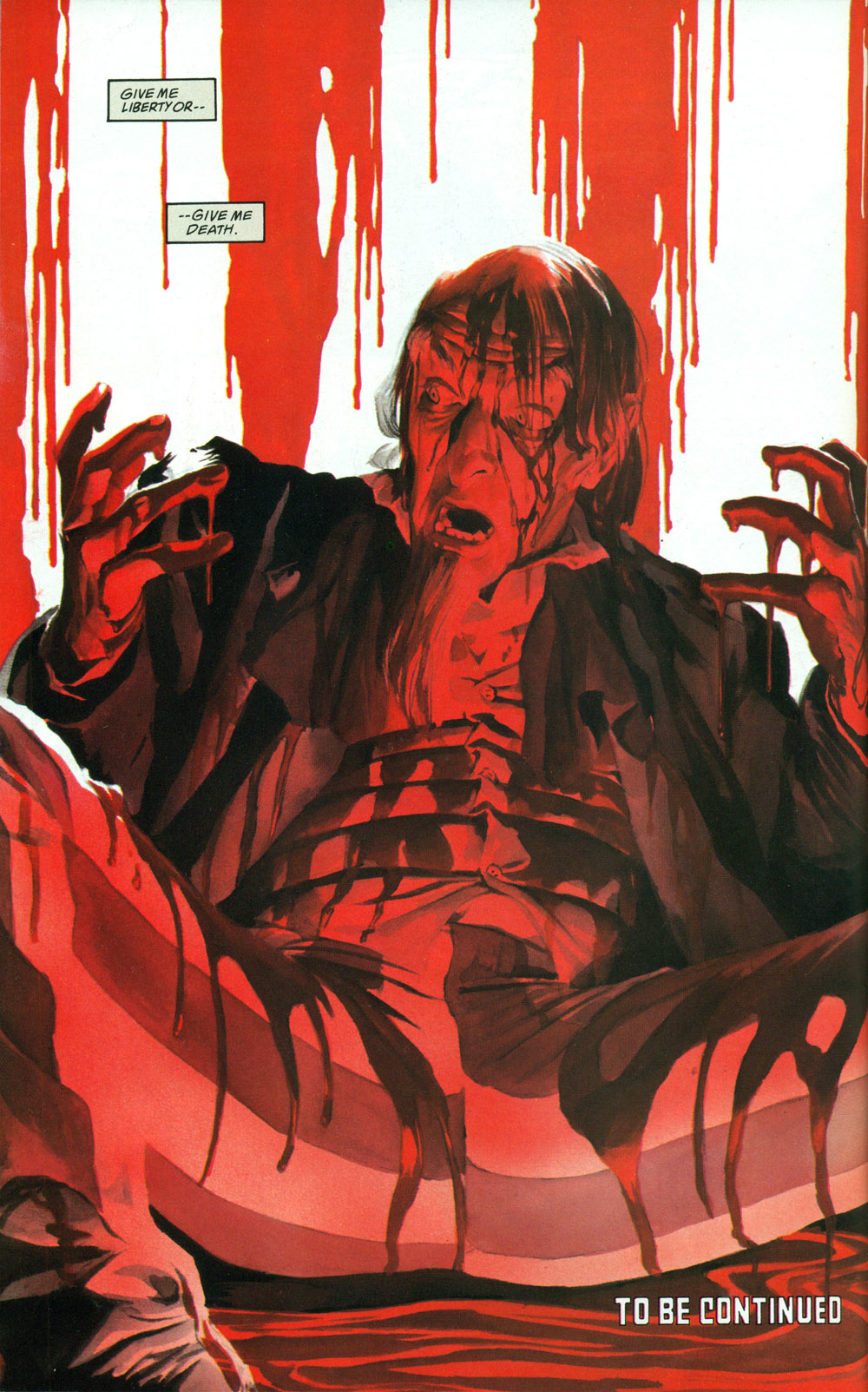
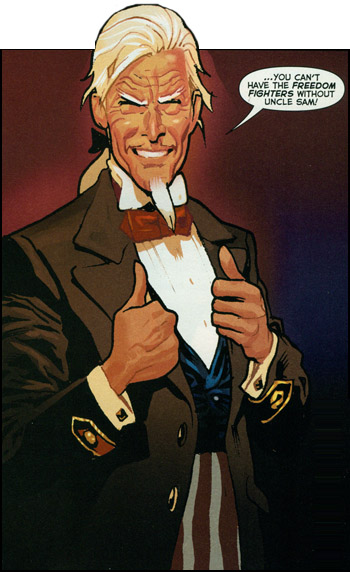
In the DC universe, Uncle Sam disappeared after World War II, as he had after past American wars. The American Talisman was further fragmented as the nation struggled with racism, corruption and an unpopular war. (The Spectre v.2 #38)
During this time, a new group called the National Interest formed to collect the pieces of the Talisman. From their base inside the former Norad Mountain, they began amassing cultural artifacts for mystical power. One of these was an alien craft acquired from Roswell, New Mexico. They could not crack its secrets—until they met Sam Wilson. Somehow the former Uncle Sam merged with the craft. His mind now resided therein, but amnesiac; the N.I. called him the Sorcerer. Wilson’s empty body was then used as cloning material to create a supernatural servant called Shadrach. (#46) Shadrach crossed paths with the Spectre, who quickly learned the importance of the fragments of the Talisman. (#37) With some difficulty, the Spectre destroyed Shadrach beyond the National Interest’s ability to repair. (#38-39, 43)
During this time, the true spirit of America began exerting its influence from beyond, reaching out to various Americans to form a new Talisman. These people included little Sojourner Tsange-Taylor and her parents Anna Tsange and Randall Abaki Taylor(#42); Madam Xanadu’s daughter, Helen Belcanto (#43-44); and American Indian twins Victorio Cutter and Tahzey Wovoka. (#46)
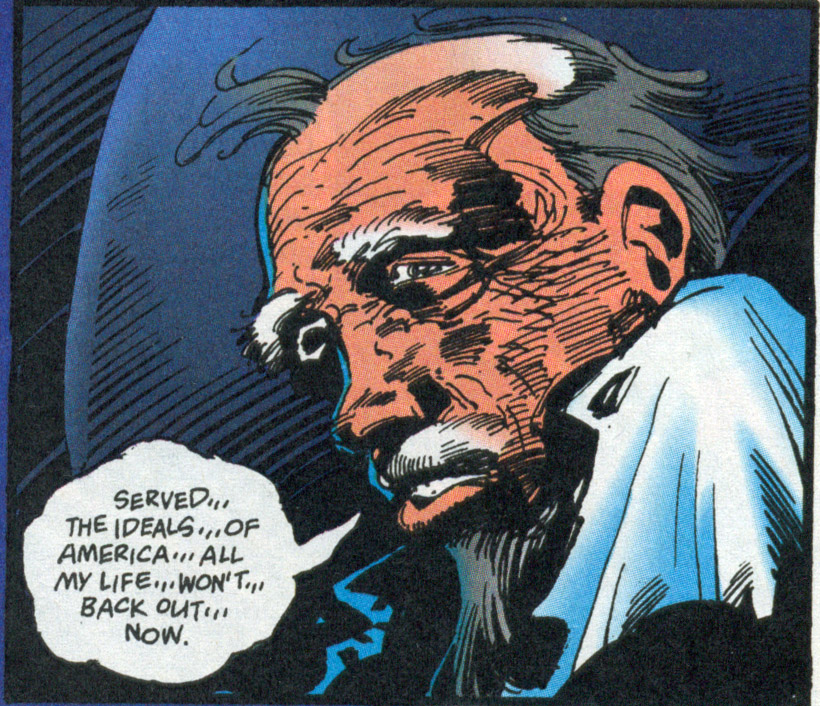
Just as these and seven others were converging on Mount Rushmore, the National Interest succeeded in reuniting all the fragments of the original American Talisman. Their aim was to recreate the avatar in their own perverted image. But the National Interest had discounted the fight left in old Samuel Wilson, inside their Sorcerer. When the Sorcerer discovered his old body lying comatose and learned what they had done to him, he rebelled against the N.I., scooped up his withered body and headed for Mount Rushmore as well. (#49)
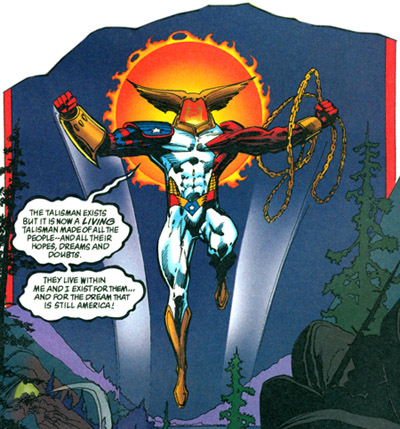
When Wilson arrived in the Black Hills, he joined the others, who were all willing to give themselves over to the creation of a new American Talisman. This time, the Talisman and its avatar were one and the same. All thirteen individuals merged to form the Patriot. The Patriot immediately sensed the danger back at Norad, where he discovered that the National Interest had succeeded in their goal. They’d created the American Scream, a vile twisted version of Uncle Sam. The Spectre destroyed the Scream. Afterwards, the Patriot returned most of its hosts to their homes. Two of them, however—Tahzey Wovoka and Sam Wilson—no longer had living bodies. Thus, the form of the Patriot was their permanent “home.” (#50)
For unexplained reasons, this Patriot was seen only once again (JSA: Our Worlds at War) before again taking the form of Uncle Sam. (Superman vol. 2 #178)
A Case of Vertigo
In 1997, Uncle Sam was the unlikely subject of a two-issue prestige series illustrated by fan-favorite Alex Ross. The events of this series don’t fit with the Spectre tale above. Still, it’s a fascinating study that finds Sam emerging from nowhere—delirious and fevered—suffering from all manner of social injustices. Most passersby dismissed Sam as a vagrant and a psychopath. But as he wandered the country, he recalled all his past lives until he remembered his true purpose. (Uncle Sam #1)
He was aided by an old friend, the former spirit of America called Columbia. This womanly spirit transported Sam to her domain, which resembled her last glory days (at the 1940 New York World’s Fair). She inspired Sam to return to America and fight again. He realized that “the only way to know how freedom works, is to work at it.” To resume his mission, he confronted an alternate version of himself, one built on greed and excess. Sam defeated this spirit—whom he admitted might be the spirit of a nation, but not of America. (#2)
Freedom Fighters: Take 3, 4
Uncle Sam was next seen several times leading a new band of Freedom Fighters who assisted the Justice Society. (JSA #49-51) These heroes were massacred by the Society during the “Infinite Crisis.” Sam was destroyed as well. (Infinite Crisis #1)
The Freedom Fighters were revived in full force very soon afterwards when Uncle Sam rose in response to an alien threat that invaded the White House. He recruited brand new heroes bearing the names of his old friends to rout the corruption. At the conclusion of the case, these Freedom Fighters were put in charge of the covert action organization called S.H.A.D.E. (Uncle Sam & the Freedom Fighters #1-8)
Recently, Uncle Sam was destroyed by elementals called the Renegades. (Freedom Fighters vol. 2 #2) He was soon resurrected when his friend, Firebrand, was killed by the Jester. Firebrand’s body served as the portal for Sam’s return to America. (#7)
New 52
When the DC universe was rebooted in 2010, the Freedom Fighters family of characters were completely reimagined. Uncle Sam was not among those characters; he made no New 52-era appearances.
Rebirth
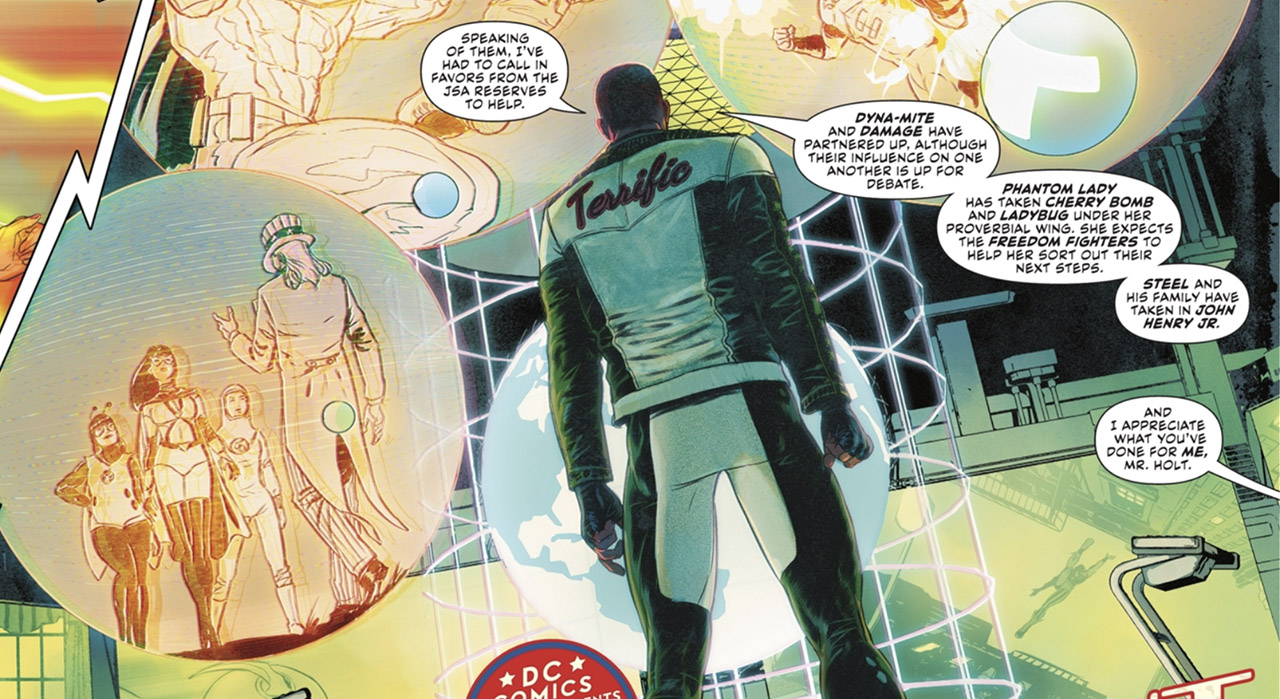
DC's "Rebirth" (2016) undid much of the New 52 and the previous version of the Freedom Fighters was restored. The Justice Society asked the Freedom Fighters to mentor two young heroes—Ladybug and Cherry Bomb. Uncle Sam was still leading the team.
Notes
Sam’s creator, Will Eisner, was drafted into the military in 1942. His byline appears on the Uncle Sam feature through National Comics #26 (Nov. 1942), but it’s unknown how long he continued to write it. Quality’s greats, Lou Fine and Reed Crandall, contributed the art throughout much of the feature’s lifetime.
In some ways, Sam and Buddy parallel Captain America and his boy sidekick, Bucky. Sam debuted in 1940, a year before the Marvel legend (Captain America Comics #1, March 1941).
Powers
Uncle Sam is fast, strong and nearly invulnerable. It was clear that he could neither fly nor teleport, but he found himself in battle all over the world. He was a “universal translator,” couldn’t be photographed, and had to hold his breath underwater.
He was privy to counsel from the spirits of other historical American figures, including George Washington, Capt. John Paul Jones and Miss Columbia. Buddy Smith was also able to see these spirits.
In many of Sam’s cover and DC appearances, he is depicted towering over landscapes, but he didn’t exhibit size-changing ability, per se, in his National Comics adventures.
Big Bang Comics
Big Bang Comics is known for its homages, and this issue feature Protoplasman als featured this "house ad" with "Miss Firecracker, Uncle Sam's favorite Niece!" From Big Bang Presents #1 (July 2009).

Appearances + References
» FEATURED APPEARANCES:
- Crisis Aftermath: The Battle for Blüdhaven #5
- DCU: Brave New World #1
- JSA #49–51
- JSA: Our Worlds at War #1
- Justice League of America #107-108
- Secret Origins v.2 #19
- The Spectre v.3 #37-50
» SERIES:
- National Comics #1-45 (July 1940–December 1944)
- Uncle Sam Quarterly #1-8 (Autumn 1941–Fall 1943)
- Freedom Fighters, v.1 #1-15
- Uncle Sam #1-2 (1997)
- Uncle Sam & the Freedom Fighters v.1, #1-8
- Uncle Sam & the Freedom Fighters v.2, #1-8
- Freedom Fighters v.2 #1-9
» SEE ALSO: