

Black Condor
Created by Will Eisner and Lou Fine

Black Condor I
NAME + ALIASES:
Richard Grey, Jr., aka Senator Thomas
Wright
KNOWN RELATIVES:
Major Richard Grey (father, deceased), Mrs. Grey (mother, deceased)
GROUP AFFILIATIONS:
All-Star Squadron, Freedom Fighters
FIRST APPEARANCE:
Crack Comics #1 (May 1940)
The Original Black Condor (Quality Comics)
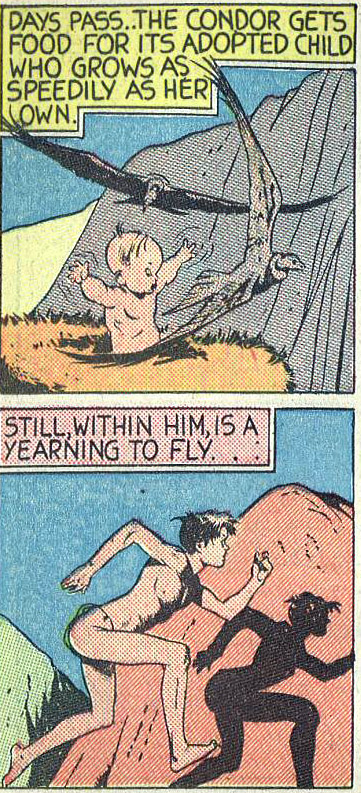
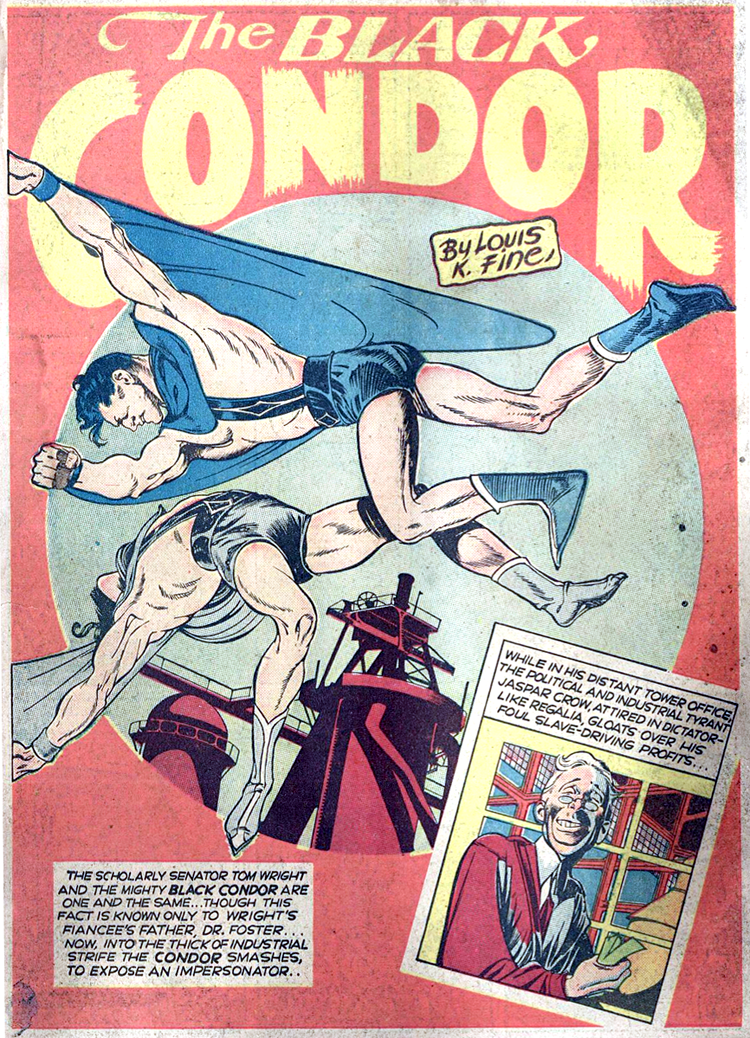
The Black Condor is one of Quality’s most enduring and popular creations. Like the Ray and Uncle Sam, he was created by Will Eisner and Lou Fine (here, under the pen name “Kenneth Lewis”). Fine’s art on these features quickly set the bar for artwork at Quality. No doubt the “Black Condor” feature would have lasted longer had Fine remained on it. He drew the Condor’s first 24 adventures, and signed his true name beginning with issue #13. The Black Condor nabbed alternating covers of Crack Comics through #26 (when Captain Triumph took over).
In his first adventure, the Black Condor’s costume was colored red, then changed to black-and-blue after that. Various stories describe the Black Condor as the “only flying man in the world.” Although the Ray had also debuted by then, it is a telling phrase. Despite the proliferation of super-powered heroes in comic books, few—including Superman—had yet to demonstrate the true power of flight.
The Black Condor was destined never to know his given name. He was born Richard Grey, Jr., the son of archeologist Major Richard Grey. When he was yet an infant, his family went exploring in Mongolia, where they were besieged, and both his parents were murdered by raiders. Before her death, the baby’s mother hid him away so he might survive. In this remote land, the only living things were the native condors, with whom the infant Grey seemed to make a connection.
Not long before, a meteor crashed near the mother condor’s nest. The radiation from this meteor created a strange bond between her and the infant Grey, and she adopted him as one of her own. (The meteor was the only detail added to this origin by Roy Thomas in Secret Origins #21, 1987.)
As he grew, the boy studied the mechanics of flight, and eventually succeeded in emulating it. He had grown to adolescence before meeting another human, the monk named Father Pierre. It was Pierre who taught the boy how to speak English, but his mentor also fell prey to raiders led by Gali-Kan. Afterwards the boy committed himself to using his gift of flight to combat injustice. As the Black Condor, he made a name for himself across continents and got revenge on the men who murdered Pierre. (Crack Comics #1)
After some adventures, the Condor returned to India, where he defended a British brother and sister, the Kents, from Ali Kan. In doing so he brandished a new weapon he’d acquired somewhere along the line: a “paralyzing black ray gun.” (#2)
On his first trip to America, the Black Condor served as protector to a friend’s daughter. Not surprisingly, he didn’t care for the city. (#3) He remained for a time in the Far East, sometimes disguising himself as an old wanderer. Even there the Axis menace had spread. The Condor encountered Sinh Fang and his cohort De Graf in their “unconquerable” fortress called Mount Doom. This place went up in a blaze generated by the villains’ own powerful death rays. (#4)
He fought a coterie of exotic foes like the strange Karlo Klug, who at the direction of his midget master launched an army of “human kites.” (#6) And there was Yaho, a giant golem of the Waquo Indian tribe. (#7)
In a memo from Busy Arnold to Will Eisner, he specifcially mentioned “Black Condor” saying: “The Black Condor … should be a definite personality who operates as The Black Condor only in times of necessity. Originally you had The Black Condor brought up by birds when his parents (British) were killed by outlaws. I don’t believe that he should be British and in any ‘build up,’ you should naturally assume that he is an American.” The shift happened soon enough. The adventure in Crack #8 seemed to take place on American turf; the Chinese Lung Woe created the drilling “spinning death machine” for his Nazi cohort. This machine turned out to have a mind of its own and manufactured an army of itself! The black ray gun took care of it. (#8)
When he returned to the land of his birth, he flew all the way from New York to Chicago and saved the life of an immigrant man. (#9) Lou Fine's artwork became a little less fine at this time, perhaps because of Busy Arnold wanted the artist to do the inking only. In his next case, he went undercover as “Blackie Wing” to bag a pair of jewel thieves. (#10)
While the Black Condor was borne of Asia, it was America where Richard Grey Jr. found his mundane identity. There he happened upon Senator Tom Wright. The Senator was beleaguered by fellow Senator, Jaspar Crow, who attempted to bully others into voting for an appropriations bill that would provide kickbacks. Wright refused, and Crow sent his thugs to rub him out. All this went down under the watchful eye of the Black Condor, who swooped in after Wright had been shot. As Wright explained his situation, the Condor realized that the two of them were dead ringers for one another. The Condor decided to take Wright’s place in Washington and vote against Crow’s bill. But when he returned to check on Wright, the Senator had died. He then met the man in charge of his care, Dr. Foster, who was also the father of Wright’s fiancé, Wendy Foster. The Condor vowed to take up the Senator’s agenda and led a revolt that drove Crow from the country. It was less easy to step into the relationship with Wendy… (#11)
From this point forward, most of the Black Condor’s battles were intertwined with his life as a Senator. He solved the murder of inventor Carl Stark, who created a remote control bomb that was used to destroy ten tall buildings! The culprit was a Nazi, General Korn. (#13)
Jaspar Crow was a constant thorn in both Wright’s and the Condor’s sides. After his first defeat, the Senator began a long descent into darker evil that was manifested in his private endeavors, too. His dictatorial complex even led him to create an impostor Black Condor to attack his own workers, who were poised to strike. The true Condor infiltrated this plant and frightened Crow into paying his workers properly and agreeing to humane working conditions. (#14)
When Senator Wright sided with the nation’s Indians on a proposed tax bill, Crow objected because, naturally, he stood to gain from it. Fifth Columnists incited the Indians, who then turned on the tax collectors. Using his black ray, the Condor turned some of the Indians to his side, but he was ultimately forced to win that war entirely himself. Then he went back to the Senate to help defeat the final bill. (#17)
Crow hired a psychic fraud called Mysto to steal the Hope Diamond, (#20) but most of his treachery was centered on Wright himself. The Condor discovered that Crow bugged the Senate and Sen. Wright was implicated in leaking secret information. Wendy stepped in to help on this case by using her wiles on Wright’s rival, Karle Kurt, a Nazi spy. (#21) Jaspar Crow somehow uncovered the fact that Mongolia was the Condor’s home land and chose that place for his ultimate revenge. Crow kidnapped Wendy, leaving clues for the Condor about Mongolia. Crow foolishly thought he could leave the Condor and Wendy at the mercy of predatory eagles, but he underestimated the Condor’s special relationship with the birds. After defeating him, Black Condor left Crow to wander the unforgiving mountains. Crow never returned. (#26)
With the entrance of America to the war, the Senator’s duties kicked into high gear. Wendy also helped her father to develop a special “food concentrate” for Europe. (#22) Jed Hawks tried to warn Wright of the Japanese attack on Pearl Harbor—but he’d been out of commission and arrived after December 7. Hawks also carried word of a second attack, on the Panama Canal. This attack did indeed commence but Hawks took to the skies and made a suicide dive into a Japanese ship. The Black Condor disabled the Nazi’s ship and the Germans there surrendered. (#23)
Senator Bird took Crow’s place as Wright’s nemesis in Congress. He wanted to create a national park for the protection of bald eagles and Tom was key in shelving the bill. Bird responded by ordering his eagle, Fury, to pick off the committee members. (#30)
The Condor aided Professor Tinker and his weird, invisible and prescient Do-Bos. When crooks sought to acquire these entities, Tinker’s place was set aflame, allegedly killing the Do-Bos. (#27) In his swan song, the Condor defended one fellow Senator (Briggs) from another (Logan). (#31)
Notes
The Super DC Calendar 1976 gave Black Condor's birthday as November 15.
DC
The next time the Black Condor appeared, it was at DC Comics. In 1973’s Justice League of America #107, Tom was reintroduced to readers along with other former Quality heroes as the Freedom Fighters. This story and the successive Freedom Fighters series are no longer in DC continuity.
The Black Condor’s DC continuity more-or-less picks up from his Quality appearances, in All-Star Squadron, set in the early days of World War II. After the U.S. entered the war, the Black Condor decided to enlist his services with the All-Stars. At his first meeting, he met Uncle Sam and joined his splinter group called the Freedom Fighters. They moved to stop Baron Blitzkrieg’s invasion of Santa Barbara, California. (All-Star Squadron #31) For the remainder of the war, the Black Condor remained with this group, who eventually separated from the All-Star Squadron and were based in Washington D.C. (Who’s Who ‘87 #5)
Tom was still active in the mid-1950s when he met Spitfire, the son of the Ray. (The Ray vol. 2 #18) At some point after this, Black Condor became a member of a secret society whose goal was to influence the course of history. After that he appeared only in an astral form and explained that he had “graduated to a higher plane of existence.” (#20) For more about his modern appearances, read about his successor, below.
Notes
Another one of Quality’s flying heroes, the Raven, shared the same last name as the Condor: Tony Grey. The Raven came two years after Black Condor (Feature Comics #60, Sept. 1942). No link was ever made between the two.
The Black Condor was the inspiration for the character called Kondor in John Arcudi’s 2002 Elseworlds series, JLA: Destiny. This character was a super-human.
Powers
In his DC origin, the Black Condor was said to be powered from exposure to radiation from a meteor. This gave him the innate ability to fly, which he developed through adolescence. In the original tale, he developed his power independently. He had an empathic relationship with the condors that raised him, and could communicate with them. When confronted by trained eagles, however, he was unable to command those birds. The Condor also employed a “black ray gun” that rendered things immobile, cut them, and could be used with force.
The original Condor exists in some sort of supernatural state which allows him to apparate instantly anywhere. He also controls to whom he is visible.
Appearances + References
» FEATURED APPEARANCES:
- All-Star Squadron #31-35
- Black Condor #4, 10
- Justice League of America #107‑108
- The Ray vol. 2 #10, 18, 20-21
- Secret Origins vol. 3 #21
- Uncle Sam Quarterly #2
» SERIES:
- Crack Comics #1-31 (May 1940–Oct. 1943)
- Freedom Fighters, vol. 1, 15 issues (1976–1978)
» SEE ALSO:
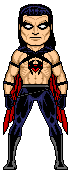
Black Condor II
NAME + ALIASES:
Ryan Kendall
KNOWN RELATIVES: Unnamed father, Creighton Kendall (grandfather)
GROUP AFFILIATIONS: Primal Force, Freedom Fighters
FIRST APPEARANCE: Black Condor #1 (June 1992)
Ryan Kendall
Created by Brian Augustyn and Rags Morales
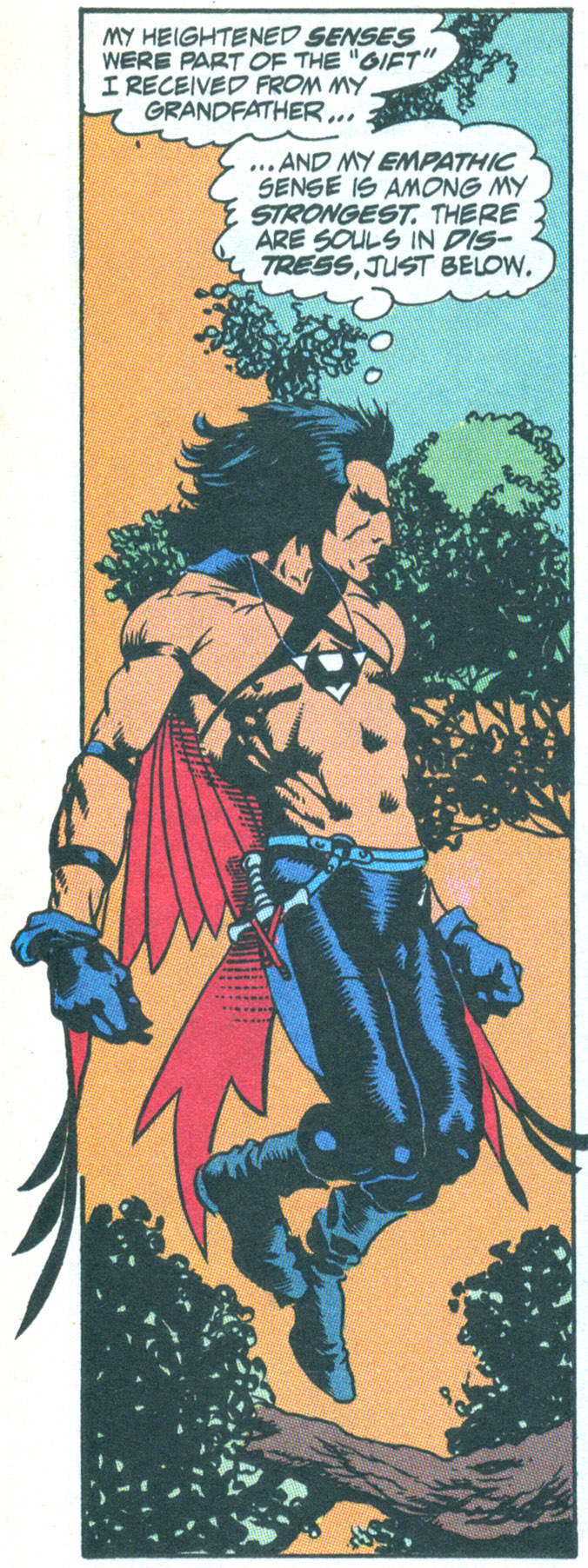
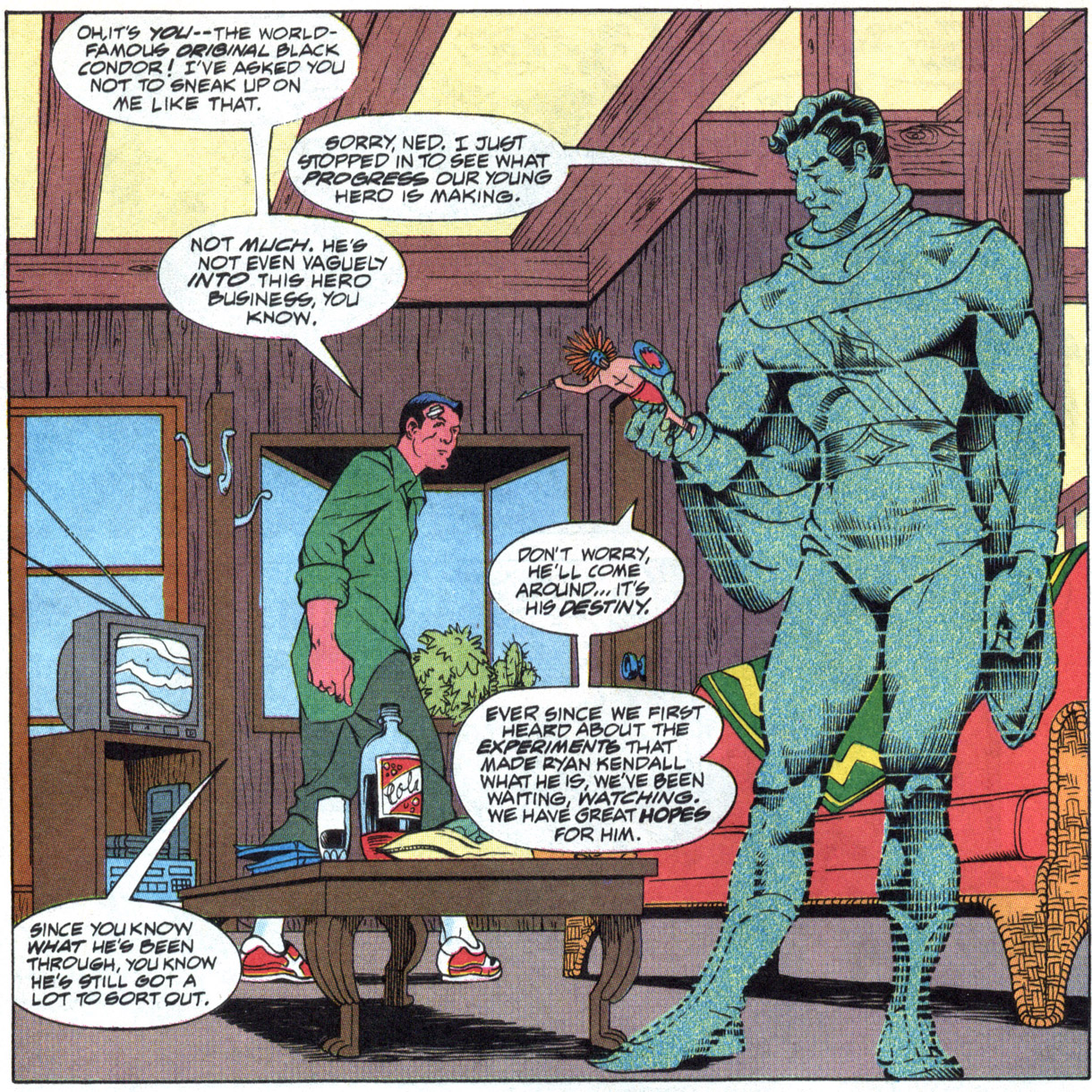
Ryan Kendall’s destiny as the second Black Condor was engineered by his grandfather, Creighton Kendall. For 200 years, the Kendall family’s Society of the Golden Wing had strived to make humans into super-humans. Ryan’s own father was a victim of Creighton’s experiments, among untold others. Creighton himself was disfigured by the experiments: left with a monstrous arm and wheelchair-bound. Ryan’s transformation was the first which did not result in death or in driving the subject mad. The Society gave Ryan enhanced mental powers which mostly manifested in the power of flight (via telekinesis), and heightened senses.
After his transformation, the new Black Condor fled from the Society. He no longer chose to identify as “Ryan Kendall” and eschewed use of the name. Neither did he like the label of “super-hero.” The Condor settled in near Philadelphia, where he was guided by his friend, the park ranger Ned Smith. (Black Condor #1-2)
Unknown to the Condor, Ned was being visited by the original Black Condor, who appeared to him in a spectral form. This Condor claimed that it was Ryan’s “destiny” to do greater things. As to his own fate, Wright was now a part of a secret society who watched the events of the world from some removed place. Wright urged Ned to guide the new Black Condor to greater heroics, but was evasive about his own existence. His society had watched Ryan’s transformation, but had its reasons for not approaching Ryan directly. (#4)
Despite himself, the new Black Condor was quick to intervene when innocents were in danger. His first major quarry was Miles Lydecker, who had invented levitation using hypersonic vibration. Lydecker turned to crime as the Sky Pirate, but the Condor actually guided him to a more righteous path. (#2-3)
Ryan’s encountered some of the Society’s other victims, finding that he shared a sort of link with the evil Shark, who sought an alliance to rule over people. During their battle, Condor discovered a shared psychic bond, which he used to shut down the Shark. (#4) More strange was the homeless girl named Karin Webster, whom the Society “blessed” with potent psychic abilities. (#5)
Black Condor met his contemporary, the Ray, for the first time after a bomb triggered Ryan’s transformation into a reptilian creature. The Ray emerged to stop him while the Condor mutated further. The original Condor surfaced again during this melee to explain that Ryan had been enveloped in a healing cocoon to help with his injuries. (#8-10)
Despite the Condor’s personal growth, his predecessor abandoned hope of him ever becoming that secret society’s champion. The original Condor moved on to a new protege, the Ray, who also had no interest in the position. (The Ray #20-21)
The new Condor was anything but a “joiner,” but perhaps that changed after he met Batman. (#12) Before long, he was approached with an offer to join the Justice League. Condor emphatically declined but sensing something amiss, followed anyway. (Justice League America #71) He became caught up in the JLA’s battle with Dr. Destiny, but did not accept membership, and left afterwards. (#73-75)
If the Justice League wasn’t the right fit for Black Condor, then perhaps he felt more at home with the ancient and mystical group called the Leymen. (Primal Force #8) The Condor briefly aided this primal force of heroes against threats such as Mind Grabber Kid (#10-11) and the August, (#12) and Cataclysm, Lord Satanus, and the Tornado Tyrant. (#13)
Ryan later relocated to Opal City, where he occasionally aided Starman, Jack Knight. (Starman vol. 2 #56) He decided to relocate to Opal after investigating the crimes of the Shade, and he encouraged Jack Knight to lead a group of heroes to that end. (#69-73) Afterwards, Knight retired and the Condor stayed in Opal, defeating villains like Catman and Socrates Jones. (#80) He also joined Uncle Sam’s Freedom Fighters, assisting the Justice Society against Mordru. (JSA #49-51) These new Freedom Fighters were among the most high profile losses during the second so-called “Crisis.” Luthor’s evil Society killed Ryan and several other members of the team. (Infinite Crisis #1)
Notes
Because of the coloring and facial features, many readers assumed that Ryan Kendall was a Native American. Editor Christopher Priest (then Jim Owsley) refuted this in a letters column. Both Priest and Brian Augustyn seeded many DC books with the Black Condor and the Ray, including their own series, Justice League America and Justice League Task Force.
Powers
Ryan Kendall’s powers were mental in nature. Their primary manifestation was a form of telekinesis that enabled him to fly. He also employed this telekinesis to free himself from under rubble, to cause a gun to explode, and to add to his own strength. His senses were heightened so that he could project his mind out from his body. To this effect, he could cause mental agony in others, and “see” beyond his own body, even while unconscious. His hearing was sufficient to hear through the walls of a concrete building. When gravely injured, Ryan was enveloped by a strange, hard cocoon which sped his healing.
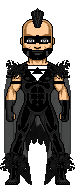
Black Condor III
NAME + ALIASES:
John Trujillo
KNOWN RELATIVES: Tse “James” Natseway (cousin)
GROUP AFFILIATIONS:
Freedom Fighters
FIRST APPEARANCE:
Uncle Sam and the Freedom Fighters v.1 #3 (Nov. 2006)
John Trujillo
Created by Jimmy Palmiotti, Justin Gray, and Daniel Acuña
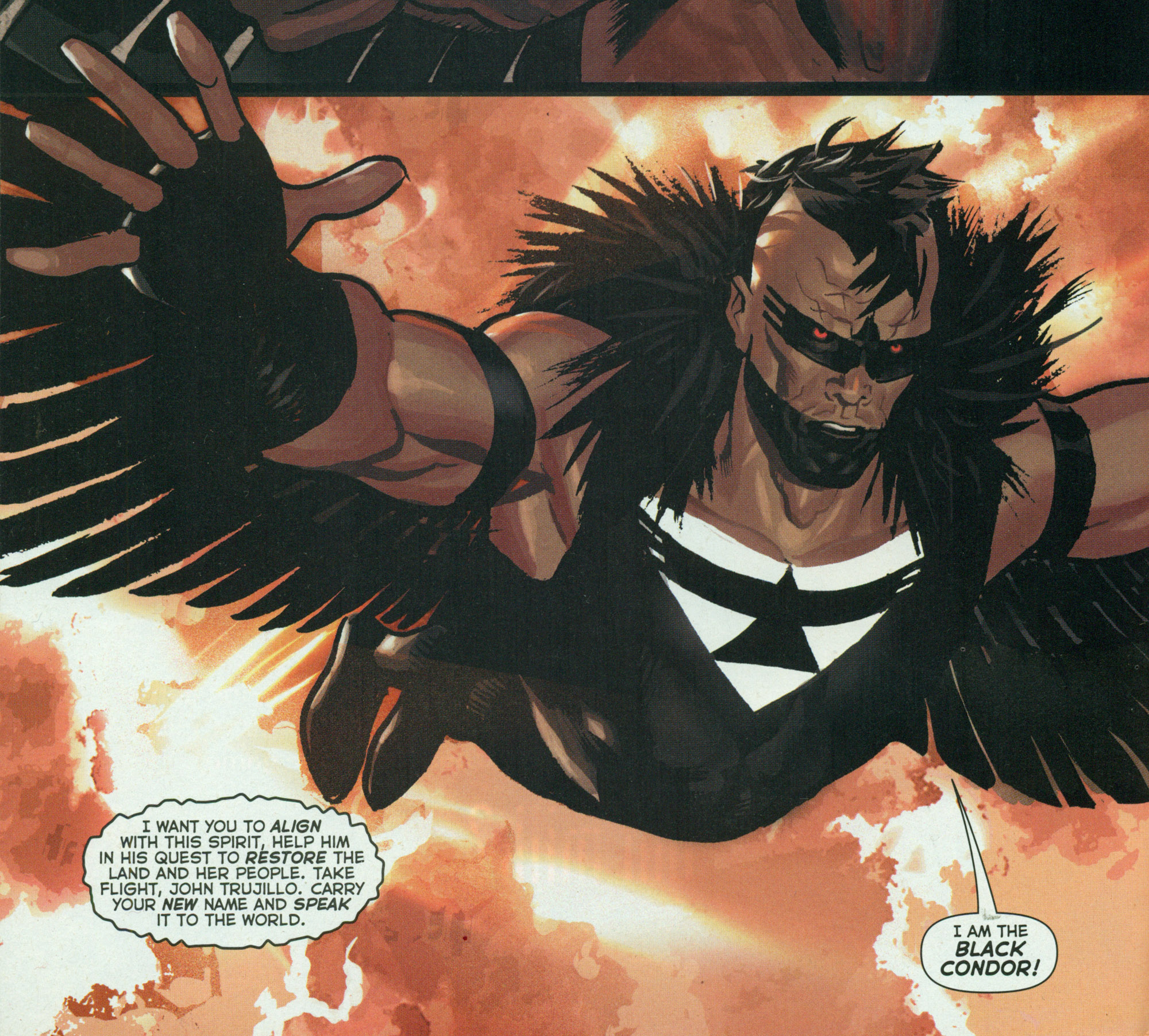
The third Black Condor was recruited by Uncle Sam to join the Freedom Fighters. At that time, the team was battling against the U.S. government agency called S.H.A.D.E. The F.F. met John Trujillo just after his transformation into the Condor. Trujillo lived among the Navajo, a southwest American Indian tribe. To the Navajo, the “Black Condor” had been a powerful defender since their fall to Col. Kit Carson in Arizona. After the tribe’s relocation, the condor was symbolized as the escort for fallen souls to the afterlife. When the Navajo finally returned to their own land, they were protected by this condor spirit made incarnate.
The spirit was known as the goddess Tocotl, the mystical Spider Woman, and first took root in a young man who begged for protection. John Trujillo was the latest in this line of Black Condors. After his journey, the Spider Woman charged him to work with Uncle Sam. (Uncle Sam & the Freedom Fighters vol. 1 #3)
Trujillo was a savage warrior and took to his mission straight away. His ultrasonic powers were able to shatter enemy shields. (#4) By nature he was emotionally distant from his teammates, but he did bond with Phantom Lady, whom he counseled after the death of her father. (#6) After exposing an alien infiltrator in the White House, the team accepted the new administration’s invitation to take over S.H.A.D.E.’s role as an American security force. (#8)
Since then, John has remained with the Freedom Fighters, honoring the Spider Woman’s directive to work with Uncle Sam. He has also given in to his feelings for Phantom Lady.
New 52
When the DC universe was rebooted in 2010, the Freedom Fighters family of characters were completely reimagined. Black Condor was not among them; he made no New 52 appearances.
Rebirth
DC's "Rebirth" (2016) undid much of the New 52 and the previous version of the Freedom Fighters was restored.
Notes
Trujillo’s co-creator, Justin Gray, characterized him thus, online: “The idea with Black Condor… was that the mythology behind Uncle Sam being representative of America, left open the idea of another mythical American figure. Condor is designed to be a force of nature, soft spoken, stoic and ferocious in battle.
Powers
John Trujillo’s power comes from the Navajo goddess Tocotl, the Spider Woman. He can fly and has super-strength and considerable invulnerability. He has also exhibited powerful telekinesis and a sonic scream.